Building on Solid Ground: The Definitive Guide to Kenyan Construction Contracts
A comprehensive roadmap to JBC, FIDIC, and PPRA frameworks for developers and contractors in 2026.
Introduction
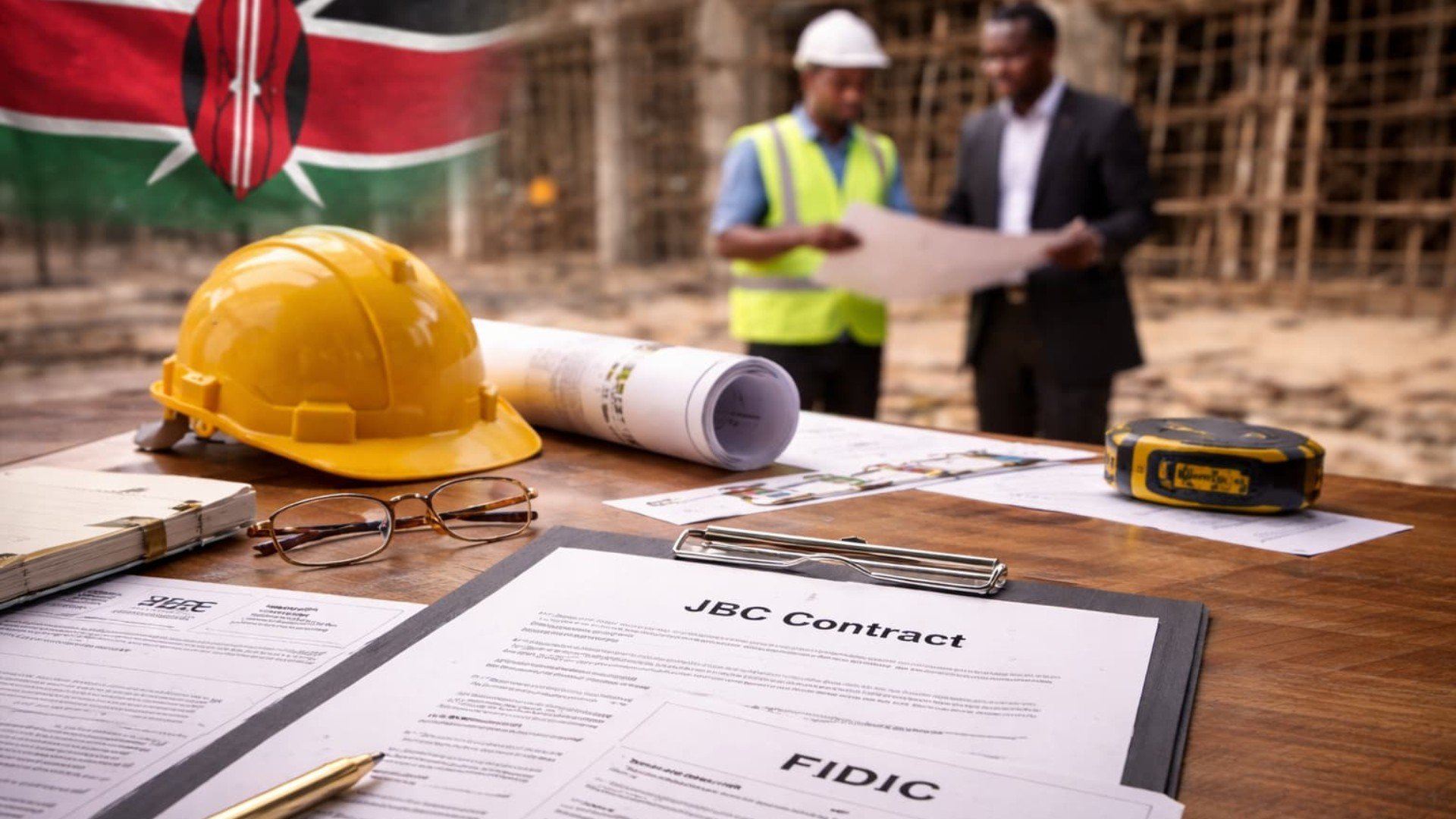
The construction industry in Kenya is evolving rapidly. With the rise of complex infrastructure projects and high-density urban developments, the "handshake deal" has been replaced by sophisticated legal frameworks.
Standard forms of contract are the "rulebooks" of construction. They define who carries the risk when prices fluctuate, who pays when the rain stops work, and how disputes are settled without ending up in a five-year court battle.
This guide outlines the essential standard forms used in Kenya today, updated for the 2026 regulatory environment.
What is a Standard Form of Building Contract?
A standard form is a pre-drafted, industry-vetted agreement. Instead of drafting a new 100-page document for every site, parties use a template created by professional bodies. These are then customized using Special Conditions to fit the specific needs of a project.
Why Use Them?
- Predictability: The clauses have been tested in Kenyan courts and arbitration.
- Clarity and Certainty: Standard clauses clearly define obligations, payment mechanisms, time control, variations, and dispute resolution procedures.
- Risk Balance: They prevent one party (usually the employer) from unfairly offloading all risks onto the contractor.
- Speed: They accelerate the procurement process from tender to groundbreaking.
1. The JBC Standard Form (The "Green Book")
The Joint Building Council (JBC) contract is the most common form for private-sector building works in Kenya. It is designed for traditional procurement where the Architect leads the design and the Contractor executes it.
- Best For: Residential houses, office blocks, and private commercial developments.
- Key Feature: Strong emphasis on the role of the Architect as the primary contract administrator.
- 2026 Perspective: While the "1999 Edition" remains the staple, many modern developers are now augmenting JBC contracts with specific Adjudication clauses to speed up dispute resolution.
2. FIDIC Conditions of Contract
The FIDIC (International Federation of Consulting Engineers) suite is the global gold standard. In Kenya, it is the go-to for large-scale infrastructure and projects funded by international donors (like the World Bank or AfDB).
- The Red Book: Used for Employer-designed civil engineering and building works.
- The Yellow Book: The standard for Design-Build projects (where the contractor handles the design).
- The Silver Book: Used for EPC/Turnkey projects (e.g., power plants or complex factories) where cost certainty is the highest priority.
- Why it matters: FIDIC is highly procedural. If a contractor fails to give a "Notice of Claim" within the strict 28-day window, they often lose their right to additional payment or time.
3. PPRA Standard Tender Documents (GoK Contracts)
For any project involving "Public Money", whether National Government or County Government, the Public Procurement Regulatory Authority (PPRA) documents are mandatory.
- Standard Tender Document for Procurement of Works: These are based on a "Measure and Value" system using Bills of Quantities.
- Strict Compliance: These contracts are tied to the Public Procurement and Asset Disposal Act (PPADA). Any variation or extension of time must follow rigid statutory approvals, or the accounting officer risks audit queries.
- Risk Profile: Generally seen as "Employer-heavy," meaning contractors must be extremely diligent with documentation to protect their margins.
4. Bespoke or Amended Contracts
Some employers opt to heavily amend standard forms or create bespoke contracts. While this may appear attractive, it often introduces:
- Unbalanced risk allocation
- Increased disputes
- Clauses that conflict with established case law
As a general rule, the further a contract moves away from a recognized standard form, the higher the legal and commercial risk.
Comparison at a Glance
|
Feature |
JBC (Kenya) |
FIDIC (Red/Yellow) |
PPRA (GoK) |
|
Primary User |
Private Developers |
International/Infrastructure |
Government Agencies |
|
Design Basis |
Employer (Architect) |
Employer or Contractor |
Employer-led |
|
Dispute Resolution |
Arbitration |
DAAB / Arbitration |
Adjudication / Arbitration |
|
Complexity |
Moderate |
High |
Moderate/Strict |
Modern Tools: Navigating Contracts with Technology
In 2026, managing a contract manually is a significant risk. Missing a deadline for a valuation or failing to document a site instruction can lead to "Liquidated Damages" that wipe out profit.
JengaLex (by Goldberry) has emerged as a critical thought partner for Kenyan professionals. It allows site managers and developers to:
- Query Clauses: "Under JBC, what is the notice period for an extension of time due to heavy rain?"
- Compare Obligations: Instantly see the difference between FIDIC and JBC insurance requirements.
- Risk Management: Identify "red flag" clauses in bespoke amendments before signing.
Frequently Asked Questions (FAQ)
Q: Are standard forms of contract mandatory in Kenya?
A: Standard forms are not mandatory for private projects, but they are compulsory for public sector works. Even in private developments, lenders and consultants strongly prefer recognized standard forms due to their predictability and legal familiarity.
Q: Can standard forms be amended?
A: Yes, through Special or Particular Conditions, but excessive amendments can distort risk allocation and increase dispute potential. Amendments should always be carefully reviewed.
Q: Can I use a JBC contract for a Design and Build project?
A: It is not recommended. The JBC Green Book assumes the Employer provides the design. For Design and Build, the FIDIC Yellow Book or the PPRA Design-Build STD are much safer choices.
Q: What happens if the contract is silent on a specific dispute?
A: Kenyan Common Law and the Arbitration Act (1995) usually step in. However, this is expensive. It is always better to ensure your Standard Form is complete with all its Appendices filled.
Q: Are "Bespoke" (custom-made) contracts legal in Kenya?
A: Yes, but they are risky. Banks and insurance companies (for Performance Bonds) often hesitate to support projects using non-standard contracts because the risk allocation is unpredictable.
Q: Where can professionals get help interpreting JBC or FIDIC clauses?
A: Apart from traditional legal advice, modern tools like JengaLex help practitioners quickly understand contract clauses and obligations, improving day-to-day decision-making.
Conclusion
A construction contract is more than a legal formality; it is a management tool. Whether you are a contractor using the JBC form for a villa in Karen or a project manager using FIDIC for a highway in Mombasa, your success depends on your ability to administer the contract's procedures.
As margins shrink, the winners in Kenya’s construction sector will be those who combine technical expertise with rigorous contractual discipline
Stay Updated
Subscribe to our newsletter to get the latest articles and insights delivered to your inbox.
Tags

Ernest Nyakundi
Ernest is the Founder and CEO of Goldberry Investments Ltd. He holds a Bachelor’s degree in Quantity Surveying from the University of Nairobi and is a member of the Institute of Quantity Surveyors of Kenya. With over five years of experience in the construction industry, he has developed strong expertise in cost management, project delivery, and emerging construction technologies.
Ernest Nyakundi
Ernest is the Founder and CEO of Goldberry Investments Ltd. He holds a Bachelor’s degree in Quantity Surveying from the University of Nairobi and is a member of the Institute of Quantity Surveyors of Kenya. With over five years of experience in the construction industry, he has developed strong expertise in cost management, project delivery, and emerging construction technologies.
Related Articles

JengaLex: The AI Expert for Construction Contracts and Regulations in Kenya
JengaLex: AI for Kenyan construction pros. Instantly query JBC, FIDIC, PPRA, and Building Code requirements for faster contract reviews and smarter compliance....

The Cost of One More Floor: Why Construction Impunity Still Kills
Analysis of Nairobi’s Jan 2nd building collapse. How unauthorized floors and construction impunity lead to fatal structural failures and loss of life....

A New Year of Building Smarter
Laying the foundation for better construction decisions with JengaLex and Cost Master...